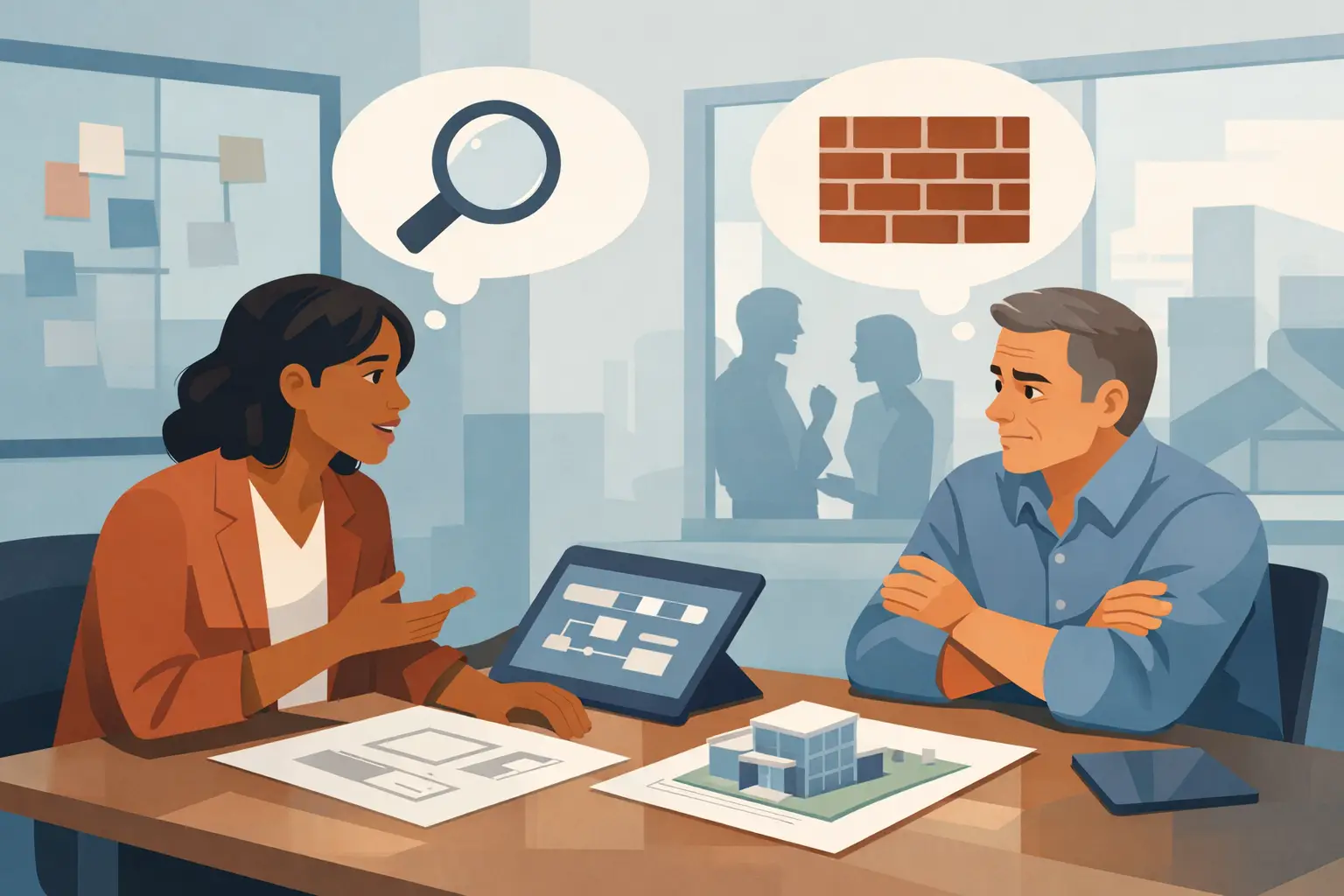

A project can be on schedule, the backlog can look healthy, and the field can still feel strained. Misalignment shows up in handoffs. Trust gets thin between operations and project teams. A strong superintendent, PM, or executive starts carrying more than their role should require. This is where construction leadership coaching becomes valuable – not as a perk, but as practical support for leaders working in high-pressure environments where people issues affect performance every day.
In construction, leadership challenges rarely arrive as leadership problems. They look like missed communication, slower decisions, team friction, change resistance, unclear accountability, or promising managers who are technically strong but not yet ready to lead through uncertainty. Coaching helps make those patterns visible. More importantly, it helps leaders respond in ways that strengthen the team instead of adding more pressure to an already demanding system.
What construction leadership coaching actually addresses
Many construction firms invest heavily in process, technology, and operational improvement. Those investments matter. But leadership challenges often persist because the difficulty is not only structural. It is human.
A project executive may know exactly what outcome is needed but struggle to bring others along without creating defensiveness. A division leader may see the need for change but underestimate how differently that change is being experienced across the organization. A rising leader may be highly dependable in execution yet avoid the conversations required to build trust and accountability.
Construction leadership coaching creates space to work on those realities directly. It helps leaders understand how they show up under pressure, how their communication affects alignment, where their assumptions may be limiting progress, and what their team may need from them during change.
That does not mean coaching offers generic encouragement or abstract leadership theory. In a construction setting, it needs to connect to real conditions – deadlines, margin pressure, safety expectations, workforce constraints, owner demands, and the constant tension between short-term delivery and long-term organizational health.
Why leadership development looks different in construction
Construction leadership is shaped by complexity. Leaders are often managing shifting priorities across office and field, balancing relationships with clients and trade partners, and trying to keep people engaged while the business itself is evolving. Growth, succession, technology adoption, and market pressure all change what leadership requires.
That is one reason off-the-shelf development programs often fall flat. They may offer useful concepts, but they miss the context. AEC leaders do not need leadership language that sounds good in a workshop and disappears on Monday morning. They need support that reflects the pace, ambiguity, and relational demands of the work.
Good coaching also respects that not every leader needs the same thing. One person may need help building executive presence without losing approachability. Another may need to lead a resistant team through a new initiative. Another may need to move from being the one with answers to being the one who develops better questions.
That last shift matters more than many organizations realize. In complex environments, curiosity is not soft. It is a leadership capability. It helps leaders slow down assumptions, surface risk earlier, understand what others are seeing, and make better decisions when the situation is not clear.
Construction leadership coaching and the human side of change
Most construction firms are asking leaders to do more with change than they did five years ago. New systems, new structures, acquisitions, labor challenges, succession transitions, and changing client expectations all place added demands on leaders. Yet many organizations still treat change as a communication task instead of a leadership practice.
Coaching helps close that gap. It gives leaders a way to think more clearly about how change lands across different roles, why resistance may be showing up, and where trust may need to be rebuilt before momentum returns.
That can be especially useful for experienced leaders. Senior people often carry the expectation that they should already know how to handle the complexity in front of them. Coaching offers a place to reflect without posturing. It allows leaders to test ideas, challenge their own thinking, and build a steadier response to uncertainty.
There is also a practical payoff. Teams tend to perform better when leaders communicate with clarity, listen with intention, and create enough psychological safety for concerns to surface early. In construction, where delays and missteps are expensive, that kind of leadership has operational value.
What effective coaching often looks like in practice
At its best, coaching is not about giving leaders a script. It is about helping them see their choices more clearly and act with greater intention.
For one leader, that might mean recognizing that directness has started to feel dismissive to the team. For another, it might mean learning how to hold people accountable without stepping into blame. For another, it may involve building confidence to lead peers after a promotion. The coaching process varies because the leadership challenge varies.
Still, the strongest engagements tend to share a few qualities. They are grounded in the leader’s actual context. They connect personal behavior to team and organizational outcomes. They leave room for reflection, but they do not stay there. Insight needs to become action.
In the AEC industry, coaching is often most valuable when it helps leaders improve in four areas at once: self-awareness, communication, trust-building, and adaptability. These are not separate from business performance. They influence whether a leader can align stakeholders, sustain momentum, and help teams stay effective during change.
When an organization should consider construction leadership coaching
Sometimes the need is obvious. A high-potential leader has been promoted and needs support. A senior executive is navigating major change. A team is struggling with communication and alignment. In those moments, coaching is a clear investment.
Other times, the need is quieter. The business is growing, but leadership habits have not evolved with it. Dependable managers are getting stuck at the same ceiling. Key people are burning out from carrying too much relational strain. Meetings produce updates but not clarity. Change initiatives are launched with energy and then lose traction.
These are not always signs of poor leadership. Often, they are signs that leaders are operating without enough support in an environment that has become more demanding. Coaching can help before frustration hardens into turnover, disengagement, or deeper organizational drag.
It is also worth saying that coaching is not a fix for every issue. If roles are unclear, strategy is inconsistent, or accountability is absent across the system, coaching alone will not solve that. But it can help leaders respond to those conditions more effectively and often reveals where broader organizational work is needed.
How to choose the right coaching approach
Fit matters. Industry understanding matters. So does philosophy.
The most effective construction leadership coaching is not built on a one-size-fits-all model. It starts by understanding the leader, the business, and the specific challenges in play. It respects the operational demands of construction while paying close attention to the human dynamics that shape performance.
That usually means asking better questions before offering answers. What is changing in the organization? Where is trust strong, and where is it thin? What leadership patterns have helped this person succeed so far, and which ones may now be limiting them? What does this team need more of from its leaders right now?
A thoughtful coaching partner should be able to hold both sides of the equation – results and relationships. If the approach is all inspiration with no application, it will not stick. If it is all tactics with no reflection, it may improve short-term behavior without building the deeper capacity leaders need for the future.
This is part of what makes a curiosity-centered approach so effective. Curiosity creates room for honest reflection without judgment. It helps leaders move past defensiveness, see more of the system they are operating in, and lead change with greater steadiness. For firms navigating growth, transition, or uncertainty, that can make leadership development feel less like remediation and more like preparation.
Connective Consulting Group often works in this space by helping AEC leaders build stronger relationships with change, strengthen trust, and improve alignment in ways that support both people and performance.
The real value is not just better leaders
The deepest value of coaching is not that one leader becomes more polished. It is that the organization becomes more capable.
When leaders communicate with more clarity, teams tend to coordinate better. When they ask stronger questions, risk surfaces earlier. When they understand how change is being experienced, resistance becomes easier to work with. When trust improves, people spend less energy protecting themselves and more energy solving problems.
That is the broader opportunity in construction leadership coaching. It helps leaders grow, but it also helps organizations create conditions where change is less disruptive, collaboration is stronger, and leadership is not dependent on a few people carrying too much alone.
For construction firms facing complexity from every direction, that kind of development is not extra. It is part of building a healthier, more resilient business – one conversation, one decision, and one curious leader at a time.
Engage Ryan to be your next keynote speaker
Ryan's Keynotes are the sparks of insight and relatable stories that function as connective tissue that helps ignite your curiosity, allowing you to begin building a stronger relationship to change.