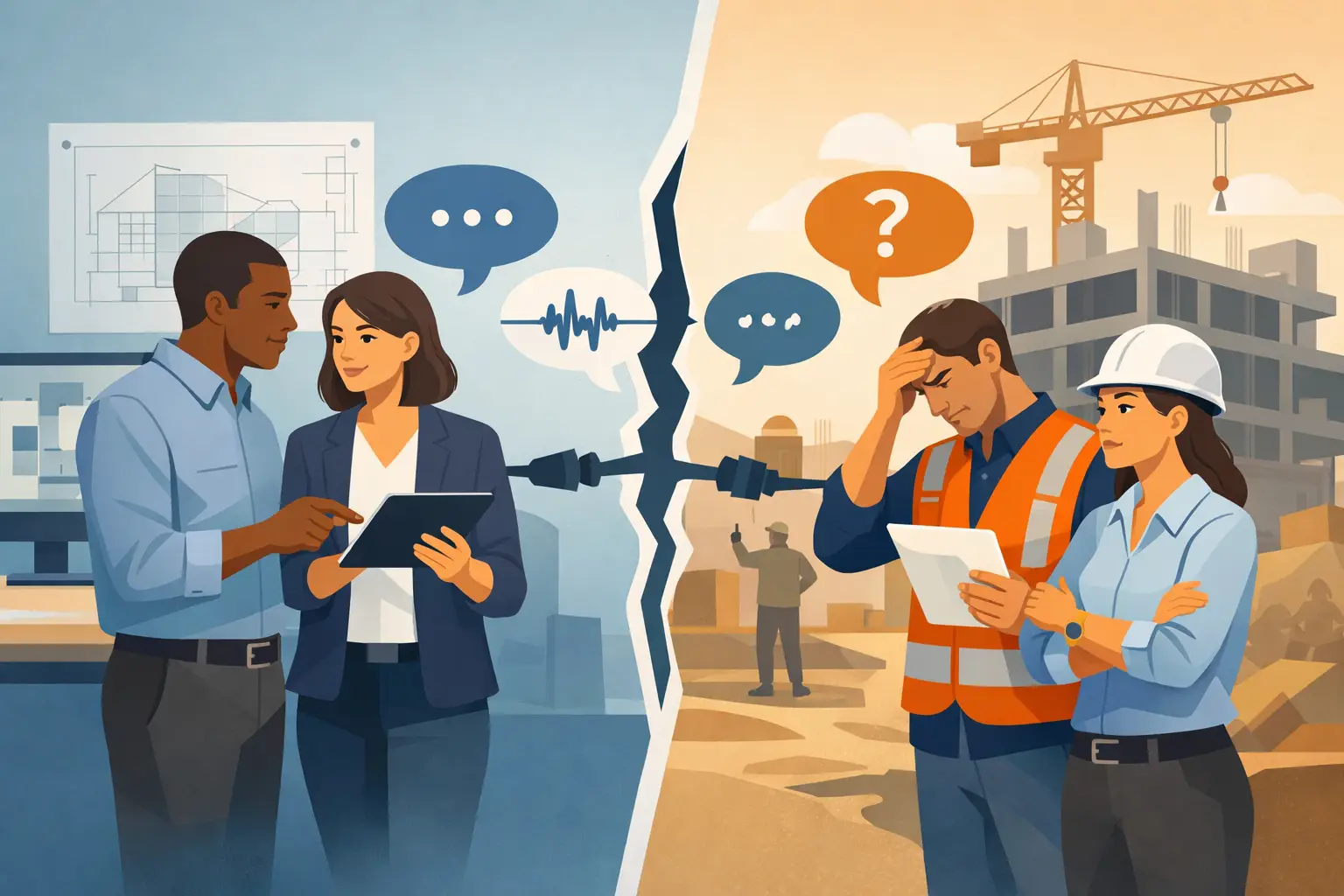

A new platform can look like a technical decision on a leadership slide and feel like a daily disruption to the people expected to use it. For AEC firms, technology often touches deadlines, project coordination, client commitments, field operations, and established ways of working. Knowing how to lead technology transitions means recognizing that adoption is not primarily a software problem. It is a leadership and relationship challenge that happens to involve technology.
A successful transition does more than get a new tool installed. It helps people understand what is changing, why it matters, what they can expect from leaders, and how they will be supported while they learn. That requires operational discipline, but it also requires curiosity.
How to Lead Technology Transitions Without Losing Trust
Leaders can unintentionally weaken trust when they announce a new system as if its benefits are self-evident. A new project management platform may promise better visibility. A new BIM workflow may reduce rework. An AI-enabled tool may speed up repetitive tasks. Those possibilities may be real, yet employees still have legitimate questions: Will this add work before it saves time? Will it change who makes decisions? What happens when the system fails on a deadline? Does leadership understand the realities of my role?
Resistance is often useful information, not a character flaw. The project manager worried about duplicate data entry may be seeing a workflow issue that has not been resolved. The superintendent hesitant to use a mobile application may be managing real constraints in the field. The experienced designer who prefers an established process may be protecting quality, client relationships, or hard-won efficiency.
Rather than asking, Why are people resisting? try asking, What are they trying to protect? That question changes the conversation. It creates room to identify risks early, distinguish fear from practical concern, and involve the people closest to the work in shaping the transition.
Trust also depends on candor. Do not promise that a change will be easy when it will require people to learn, slow down temporarily, or alter familiar routines. Name the cost of the transition alongside its intended value. People are more likely to stay engaged when leaders acknowledge the disruption honestly and demonstrate that the organization has a plan to support them through it.
Start With the Work, Not the Tool
Technology decisions often begin with product features, licensing costs, or vendor demonstrations. Those factors matter, but they should come after a clear understanding of the work the organization is trying to improve.
Before selecting or expanding a system, bring together leaders and representative users to explore the current reality. Where does information get lost between design, preconstruction, and the field? Which handoffs create avoidable delays? What workarounds have teams built because existing processes do not match how projects actually move? Which problems are technology problems, and which are decision-making or accountability problems?
This distinction matters. A new platform cannot resolve unclear roles, inconsistent leadership expectations, or a culture where teams hesitate to raise concerns. It may make those issues more visible, which can be valuable, but visibility is not the same as resolution.
Define the few outcomes that matter most. For one firm, the priority may be faster and more reliable closeout documentation. For another, it may be reducing version confusion across disciplines. A growing contractor may need more consistent project reporting without creating burdensome administrative work. Clear outcomes give teams a reason to engage and create a standard for evaluating whether the transition is helping.
Create Meaning at Every Level
Executives may see a technology transition as part of a broader strategy: preparing for growth, improving margins, responding to client expectations, or building a more connected organization. Individual team members need to understand what it means for their next project, their workflow, and their ability to do good work.
Both levels of meaning are necessary. Communicate the strategic reason, then translate it into role-specific implications. A principal, project executive, architect, project engineer, and field leader will not experience the same transition in the same way. A single generic announcement rarely answers what each group needs to know.
Managers are especially important here. They are the people employees watch when priorities compete and deadlines tighten. If managers treat the new technology as an optional side project, their teams will do the same. If they can explain the purpose, make time for learning, and bring concerns upward, they become credible guides through uncertainty.
This does not mean managers need every answer on day one. It does mean they need enough context to speak honestly, enough support to coach their teams, and a clear path for escalating questions that deserve a response.
Build Participation Into the Transition
Participation is not a ceremonial request for feedback after key decisions have been made. It is a practical way to make better decisions before the cost of change gets higher.
Include people who understand different parts of the work: project delivery, design, estimating, accounting, operations, IT, and field execution. Their input can reveal where a proposed workflow creates friction, where training examples need to be more realistic, and where a pilot should begin. The goal is not unanimous agreement. The goal is informed participation and stronger ownership.
Pilots are especially useful when the transition affects core project work. Choose a setting that is representative enough to teach the organization something meaningful, but contained enough to allow adjustment. A pilot should test more than whether the technology functions. It should examine whether roles are clear, whether support is accessible, whether the workflow fits project realities, and whether leaders are reinforcing the change consistently.
When teams identify issues, respond visibly. Not every request can be accommodated, and leaders should be clear about trade-offs. But people need to see that their experience influences decisions. Silence after feedback teaches employees that participation is performative.
Support Learning as Part of the Work
Training is necessary, but a one-time demonstration rarely produces confident use. People learn best when instruction is connected to real tasks they need to perform, reinforced over time, and available when questions arise.
Plan for different levels of readiness. Some employees will be eager to experiment. Others will need more time, practical examples, or peer support before the new approach feels credible. That is not a reason to lower expectations. It is a reason to provide multiple ways for people to build capability.
Effective support may include role-based practice sessions, short job aids, office hours, peer champions, and leaders who actively use the same tools they are asking others to adopt. The right mix depends on the size of the organization, the complexity of the technology, and the consequences of mistakes. A change to timekeeping may require a different support model than a change to design coordination or project controls.
Most importantly, protect time for learning. If people are expected to maintain full production while learning a demanding new system, leaders should expect shortcuts and frustration. The short-term investment may feel inconvenient, but it is often less costly than prolonged inconsistency, rework, and disengagement.
Measure Adoption Without Reducing It to Compliance
Usage data can be helpful. It may show whether teams are logging in, completing required steps, or using core functions. Yet activity is not the same as adoption. A team can check every box and still rely on spreadsheets, side conversations, or old processes to get the real work done.
Pair quantitative measures with direct conversation. Ask project teams what is becoming easier, what is still difficult, and where the new process is creating unintended work. Look for evidence connected to the outcome you defined at the beginning: fewer information gaps, more timely decisions, stronger coordination, or improved project visibility.
There will be trade-offs. Standardization can improve consistency while limiting local flexibility. Speed can increase while creating new quality risks. The point is not to avoid trade-offs, but to make them visible and decide which ones are acceptable for the organization and its projects.
Leaders should also be willing to adjust. If a workflow is creating unnecessary friction, changing it is not a sign that the transition failed. It is a sign that the organization is learning. Holding too tightly to an original plan can turn a manageable problem into a trust problem.
Keep Curiosity Alive After Go-Live
Go-live is a milestone, not the finish line. The most valuable learning often appears after teams begin using technology under real project pressure. Continue asking thoughtful questions, listening across roles, and making improvements that help the tool serve the work rather than the other way around.
Technology will continue to change. The leadership opportunity is to help people build a healthier relationship with change itself: one grounded in clarity, participation, trust, and the confidence to learn. When leaders approach transitions with curiosity, teams are better equipped not only to adopt the next tool, but to shape a stronger way of working together.
Engage Ryan to be your next keynote speaker
Ryan's Keynotes are the sparks of insight and relatable stories that function as connective tissue that helps ignite your curiosity, allowing you to begin building a stronger relationship to change.