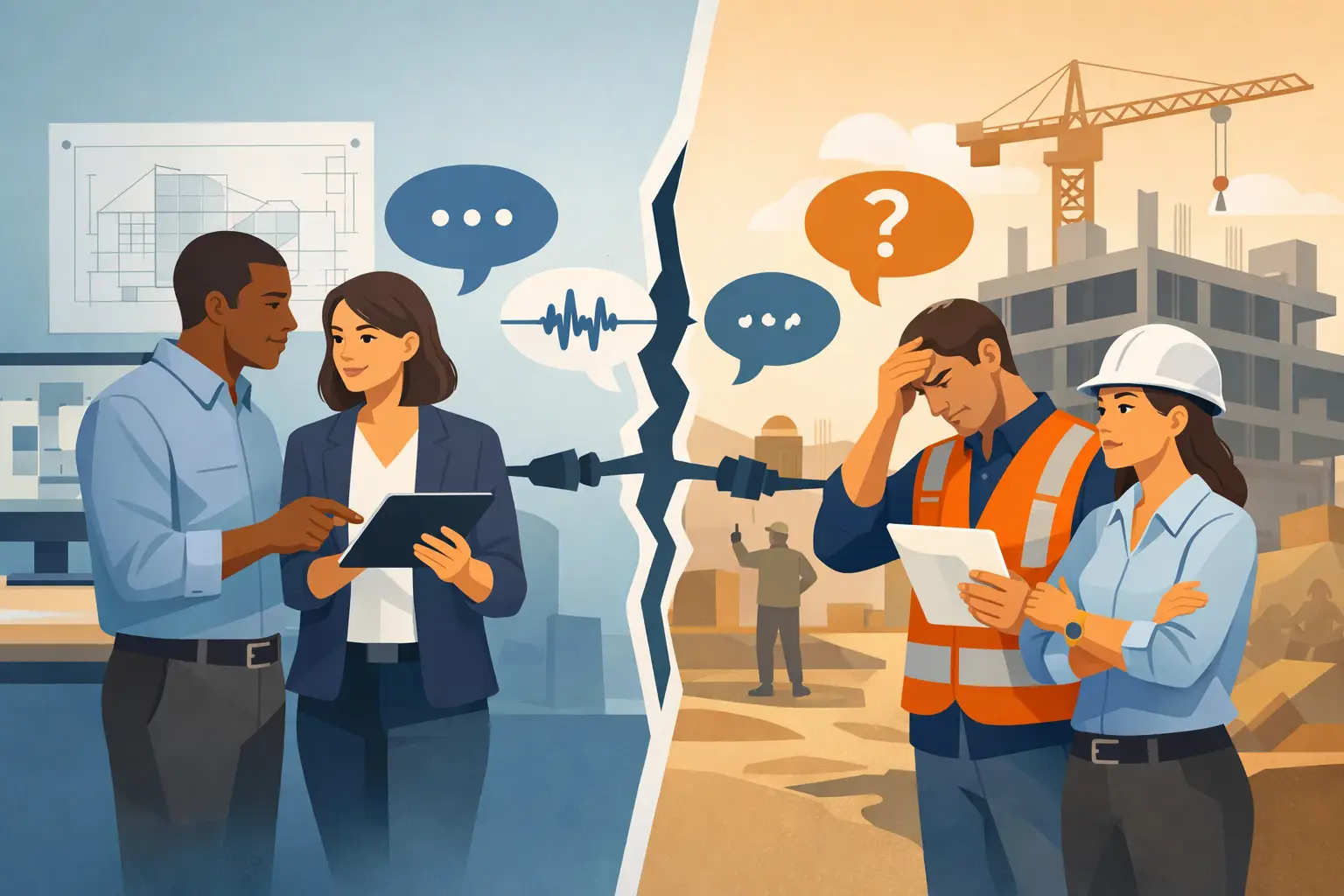
A superintendent learns about a design change after crews have already mobilized. An engineer assumes a field issue was resolved because no one raised it in the last meeting. A project executive hears that the owner is frustrated only after trust has started to erode. These are not simply coordination problems. Construction communication gaps are often the point where unclear expectations, competing priorities, and unspoken concerns become schedule pressure, rework, and strained relationships.
AEC leaders know that projects are built through hundreds of handoffs. Information moves between owners, architects, engineers, estimators, trade partners, field leaders, project managers, inspectors, and suppliers. Every handoff carries a risk: someone may interpret a message differently, receive it too late, or decide it is not their place to speak up. Better tools can help, but a platform cannot resolve the human dynamics behind a missed conversation.
Why Construction Communication Gaps Grow So Quickly
Most communication failures do not begin with people refusing to communicate. They begin with reasonable people working under real constraints. A project manager may be protecting the team from unnecessary meetings. A foreman may not want to delay work while waiting for an answer. A design lead may believe a revised drawing tells the complete story. Each decision can make sense in isolation.
The problem is that construction is an interconnected system. A small assumption in one discipline can affect sequencing, procurement, safety, quality, cost, or an owner relationship somewhere else. By the time the issue becomes visible, teams may be debating accountability rather than understanding what happened.
Communication gaps also widen during change. A merger, leadership transition, new project technology, revised delivery model, or rapid growth can alter decision rights and routines before people have had time to establish new ones. Leaders may announce the change clearly and still find teams operating from old expectations. People need more than an update. They need context, opportunities to ask questions, and a shared understanding of what changes in their day-to-day work.
The Cost Is More Than Rework
Rework is the most visible consequence of poor communication, but it is not the only one. When teams repeatedly discover surprises late, they begin to spend energy protecting themselves. Emails become more defensive. Meetings become reporting exercises rather than problem-solving conversations. Decisions move upward because people no longer feel confident acting without approval.
That pattern slows the project and weakens leadership capacity. Emerging leaders learn that raising a concern may create conflict, so they stay quiet. Experienced people stop sharing lessons because they do not believe anyone will act on them. Trade partners may comply with the letter of a request while withholding the practical insight that could prevent an issue.
The financial impact matters, of course. Yet the relational impact can be harder to repair. Owners remember whether they were surprised. Team members remember whether leaders listened when conditions changed. In a business built on repeat work, reputation, and collaboration, trust is not a soft outcome. It is operational capacity.
Look Beyond the Missing Message
When an issue occurs, the instinct is often to ask, “Who failed to communicate?” That question may identify an immediate breakdown, but it rarely reveals the conditions that made the breakdown likely. A more useful starting point is curiosity.
Ask what information was known, by whom, and when. Ask how people believed decisions were supposed to be made. Ask whether the team had a clear forum for surfacing risks, conflicts, and uncertainty. Ask what made it difficult to raise the concern earlier.
These questions shift the conversation from blame to learning. That does not remove accountability. Clear commitments and follow-through still matter. It simply recognizes that accountability is stronger when teams understand the system they are accountable within.
For example, if field teams are consistently late receiving design clarification, the answer may not be “send more emails.” The team may need a clearer escalation path, earlier constructability conversations, or agreement about which changes require a direct conversation before documentation is issued. The right response depends on the project, the contract structure, the team’s maturity, and the pace of work.
Assumptions deserve daylight
Many gaps live inside assumptions that sound harmless: “They know the schedule changed.” “That was covered in the meeting.” “The office will handle it.” “The field will figure it out.” These statements often conceal uncertainty about ownership, timing, and authority.
Leaders can make assumptions visible by building a few disciplined questions into existing conversations: What are we assuming? Who needs to know this next? What could this affect downstream? What have we not said because we think it is obvious?
This does not require adding another layer of process to every project. It requires using key moments – a kickoff, pull-planning session, owner update, design change, or weekly coordination meeting – to confirm shared meaning rather than merely exchange information.
Create Communication Agreements, Not Just Meeting Calendars
A full calendar is not evidence of alignment. In fact, too many meetings can make people less likely to surface what matters because they are rushed, distracted, or unsure where a topic belongs. Effective communication is less about volume and more about purpose.
At the beginning of a project or major initiative, teams benefit from explicit agreements about how they will work together. Clarify which decisions sit with which roles, what information must be shared before work proceeds, how urgent issues are elevated, and where final decisions are documented. Decide when a phone call or site conversation is better than another message in a crowded inbox.
The agreement should also address how the team handles disagreement. A healthy project team does not avoid tension. It creates a way to raise conflicting perspectives early, before they harden into positions. When people know that respectful challenge is expected, they are more likely to bring forward the field condition, scope concern, or client question that needs attention.
Consistency matters here. If leaders invite input but respond with impatience when concerns are raised, the stated agreement will not hold. Trust is built through repeated experiences: people speak, leaders listen, the team decides, and everyone understands what happens next.
Make Leaders the Connective Tissue
Project leaders sit at the intersection of technical delivery and human experience. Their role is not to personally carry every message. It is to create conditions where the right conversations happen early enough to matter.
That means translating strategy into practical relevance. If the organization is adopting a new project management system, explain how it will affect information flow, responsibilities, and decision speed. If a project is under schedule pressure, name the tension directly rather than pretending business as usual is possible. People can handle difficult realities better when they understand the context and have a voice in how the team responds.
It also means paying attention to who is absent from the conversation. The person closest to the work may see a risk that is invisible in a leadership meeting. A quieter team member may need a direct invitation to share. A trade partner may need clarity that honest feedback will be received as collaboration, not resistance.
Curiosity is a practical leadership capability in these moments. Instead of asking only, “What is the status?” leaders can ask, “What are we seeing that our plan did not anticipate?” Instead of saying, “Why was this not escalated?” they can ask, “What would have made escalation easier?” The difference is not semantic. One question closes a conversation; the other makes learning possible.
Turn Lessons Into New Habits
Every completed phase, difficult coordination issue, and project closeout offers information about how the team communicates. Yet lessons learned often become a document that is filed away rather than a practice that changes future work.
Choose one or two communication patterns to improve rather than trying to fix everything at once. A team might decide that design changes affecting active work always require a same-day field discussion. Another might establish a short weekly risk review with representation from design, project management, and the field. The best habit is the one people can sustain under pressure.
Then revisit it. Did the new practice create clarity or just more administration? Did the right people participate? Did decisions move faster? Did team members feel safer raising concerns? Feedback is not a final step. It is how an organization learns whether its intentions are becoming lived behavior.
Construction communication gaps will never disappear entirely. Complex work performed by diverse people will always include uncertainty, changing conditions, and imperfect information. The opportunity for leaders is not to demand flawless communication. It is to build teams that notice gaps sooner, ask better questions when they appear, and respond in ways that strengthen both the work and the relationships required to deliver it.
The next time a message is missed or an issue surfaces late, pause before assigning a simple cause. Get curious about the conditions around it. That conversation may prevent the next problem, but more importantly, it can help your team become more connected when the work gets complicated.
Engage Ryan to be your next keynote speaker
Ryan's Keynotes are the sparks of insight and relatable stories that function as connective tissue that helps ignite your curiosity, allowing you to begin building a stronger relationship to change.